Opinion. Facts are checked against Substack's own announcement and help centre, both linked below. Where I'm guessing, I say so.
On 14 October Substack shipped a settings page. That's all it is, mechanically: a page called Content preferences with some sliders and a mute list. The announcement that came with it is more interesting than the feature, because it contains a number Substack has never put in writing before, and that number changes how you should think about the platform.
Here it is:
In the past six months, the Substack app has driven nearly 800,000 paid subscriptions and more than 80 million free subscriptions to writers and creators. More than half of paid subscriptions from the app came directly from the Notes feed.
Read that twice. Substack's pitch since 2017 has been that you own your audience. Your subscribers are an email list. You can export it. No algorithm sits between you and your readers. And that's still true. But the growth engine, the thing bringing in new paying subscribers, is now a ranked feed of short posts that Substack controls, that Substack tunes, and that Substack has just handed a set of dials to.
To readers. Not to you.
What actually shipped
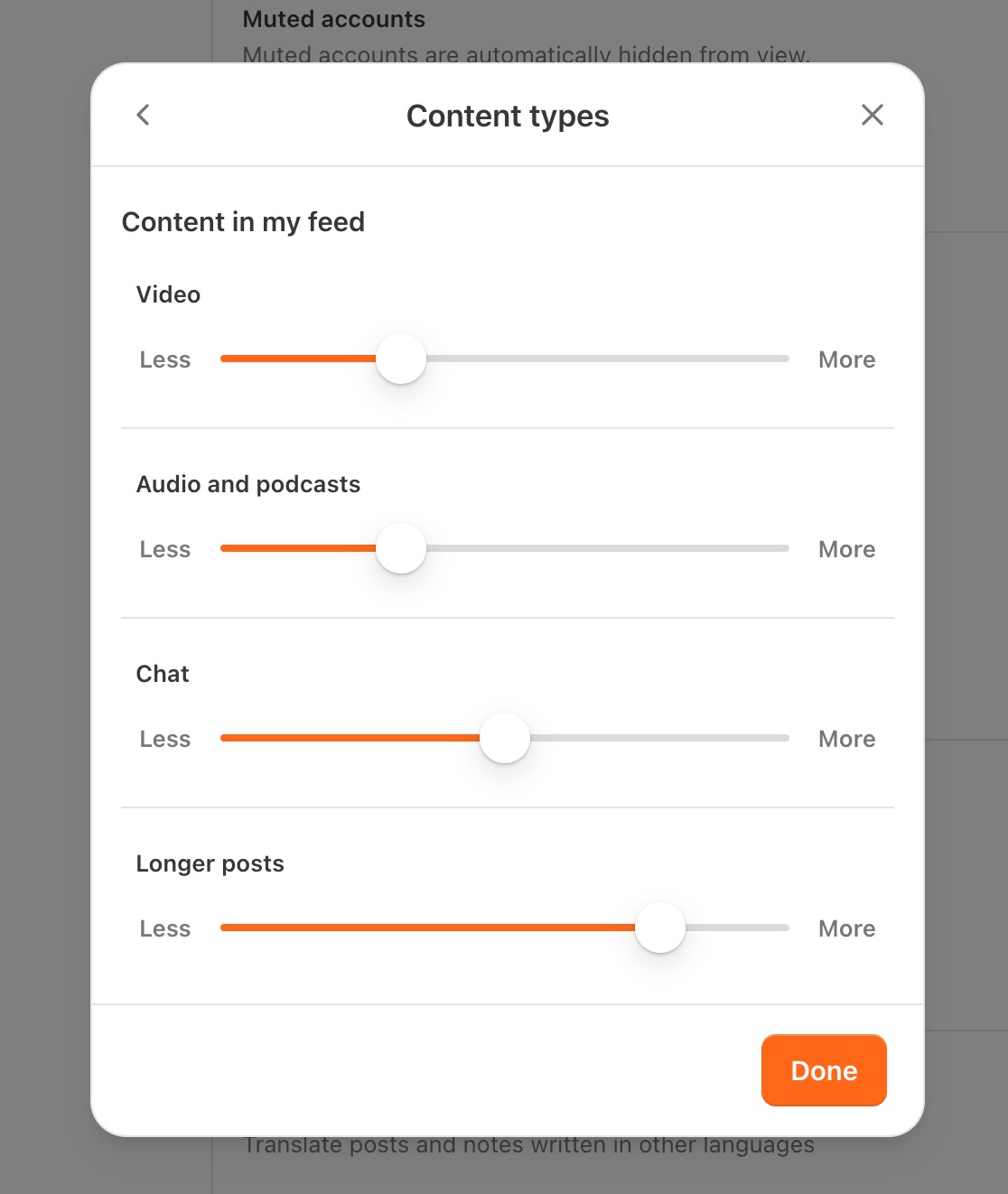
From the help centre, so you don't have to dig:
- Content type sliders. Four of them: Video, Audio and podcasts, Chat, and Longer posts. Each goes from Less to More.
- Muted words and phrases. Up to 50 entries, 100 characters each. Any post or note containing one is hidden.
- Interests. Mark topics as Interested or Not interested.
- Muted and blocked accounts. Standard.
- AI label. Off by default. Turn it on and other people's posts over 100 words get a badge when a detector called Pangram rates the text as 100% AI-generated. Here's the part I like: if an author has turned AI detection off on their own publication, their posts get a "Not scanned" badge instead. Opting out is itself a label.
It lives under Settings → Content preferences, on web and in the app. Changes apply immediately.
Every one of those controls is reader-side. There is nothing in this release for the person publishing. No reach report. No "your posts are being shown less because readers have turned down longform." No signal of any kind. If a chunk of your audience slides Longer posts toward Less, you will find out the way you find out about every algorithm change: your numbers go soft and you don't know why.
Nobody turns the dials
Here's the thing every platform that has ever shipped feed controls knows, and Substack knows too.
Almost nobody uses them.
X has a Following tab. The app opens on For You. Instagram brought back a chronological feed in 2022 after years of people begging for it; it isn't the default, and it isn't sticky. Facebook has a Feeds tab that most users have never found. Defaults are the product. The setting that exists is not the same as the setting that's used.
So what does a settings page nobody opens do?
My guess, and it is a guess: it moves the blame. For two years the loudest complaint on Substack has been that Notes turned into LinkedIn. Engagement bait, restack-for-restack, people selling courses on how to game the feed. Substack has been pushing video and live hard, and readers who came for essays have been vocal about not wanting it. Now there's a slider. If your feed is junk, you didn't tune it. The algorithm is the same algorithm. The responsibility moved.
You can read the dials as a confession, too. Each one is a complaint they got enough of to build a switch for. "Less video" exists because they overdid video. "Mute keywords" exists because the feed got noisy enough that readers wanted a blocklist. Those switches don't fix the feed. They let you hide the symptoms.
The number that matters
Go back to the quote. More than half of paid subscriptions from the app came from Notes.
That's the sentence that should change your plan if you're building on Substack. It means:
The algorithm is your acquisition channel. Not SEO. Not your email list. Not a share on X. A feed that ranks short posts by signals Substack doesn't publish. Your email list is still yours, and that's still the strongest reason to pick Substack over most of the platforms on this site. But the list grows through the feed, which means the thing you own is fed by the thing you don't.
You're writing for the feed whether you meant to or not. If half the money comes from Notes, then the writers who are growing are the ones who've worked out what Notes rewards. Substack will tell you it rewards "meaningful connection." Every platform says that. What the feed actually rewards is whatever the ranking model has learned gets people to subscribe, and the people teaching Notes growth tactics on Substack have been reverse-engineering that for a year. They were right to.
Your reach is now a function of other people's settings. This is new. Before the dials, your Notes reach depended on the algorithm. After them, it depends on the algorithm plus a few thousand private decisions you'll never see. A reader who mutes "AI" because they're sick of AI discourse also mutes your post about using AI to edit. A reader who slides Longer posts to Less has downranked your entire publication type without ever seeing it.
None of this is a reason to leave Substack. It's a reason to stop describing it the way its 2019 marketing did.
What this looks like from the rest of the directory
Every platform listed here is converging on the same shape: a feed, a ranking, and a paywall. I wrote about who decides whether your members see your post earlier this week, and this is the clearest piece of evidence for that argument since.
Skool ranks its feed by activity. Facebook ranks by whatever Meta wants this quarter. YouTube is a feed with videos in it. And now the platform that launched as the alternative to all that, the one whose founder wrote a year ago that "Substack is social media, yes, okay, it is," has shipped a For You feed with preference sliders. It's a social media app with an email export. That's not an insult. It's the most honest description of the product, and it comes from Substack's own numbers.
The places where the creator still controls distribution are shrinking to two: email, and chronological chat like Discord. Everything else is somebody else's ranking.
Three things to do about it
Treat the feed as a channel and measure it like one. Substack's dashboard will show you where subscribers came from. Look at the Notes share. If it's over half for you too, you're running a social media account that happens to have a newsletter attached, and your time should go where the number says.
Keep the list warm independently of the feed. The whole point of Substack is that the list is portable. A list that only grows through Notes and only gets opened because of Notes is portable in name only. Email your people directly, regularly, with something worth opening, so that if the feed turns on you (and feeds always turn), there's a relationship that doesn't depend on it.
Decide what you think about the AI badge before it decides for you. The label is off by default for readers, so most won't see it. But it will spread, and "Not scanned" is a worse badge than no badge. If you use AI in your process, which most working writers now do in some form, say so somewhere readers can find it. Being labelled is fine. Being labelled by a detector you opted out of is not.
The quiet part
Substack's post ends with "On Substack, you're in control: of the culture you support, the audiences you build, and now, the feed you scroll."
Every word of that is addressed to a reader. The people the directory exists for, the ones building the audiences, got one line: "This level of control serves both the creators who share their work here and the people who come to discover and enjoy what they publish." That's it. That's the creator's share of a release that affects how every creator on the platform gets found.
I don't think that's malicious. I think it's what a platform looks like when its growth comes from a feed. The reader is the user. The creator is the content. Substack was supposed to be the place where that wasn't true, and for the email part of the product it still isn't. But the email part isn't where the growth is anymore, and Substack just told us so.
Sources: Substack's announcement, "You told us you wanted more control over your feed. Here's the dial," 14 October 2026; the help centre article "How do I control what I see on my feed on Substack?"; and Hamish McKenzie's "Substack is a social media app." Checked 17 October 2026.