This is an opinion piece. Where I'm guessing, I say so. Where there's a number, I say where it came from. If you were there and remember it differently, I'd like to hear it.
Cold open
Pull up any blog post from 2011. Scroll to the bottom.
Odds are you'll find a graveyard. A grey box that says "Comments are closed." Or a Disqus thread with forty replies, the last one dated 2014, half of them from accounts that no longer exist. Or nothing at all, just a smooth cut from the last paragraph straight into "Related posts," like the bottom of the page was amputated and the wound healed over.
In 2011 the comment section was the whole point. A post without comments was a failure. Bloggers counted them like YouTubers count views. There was an entire mini-industry of plugins whose only job was to get you more of them, and a second mini-industry built on borrowing somebody else's commenters. The comment box was where the blog became a community, and "building a community" was the thing every guru told you to do.
Fifteen years later the comment box is a vestigial organ. Most sites removed it. The ones that kept it mostly get spam. The companies that built the tools were bought and gutted, or quietly shut down, or became something their users hated.
So the question I kept turning over while building this directory, which is a directory of places people go to have the conversation that used to happen under blog posts, is a simple one.
Who killed commenting?
It turns out there's a body. There are fingerprints. And there's no shortage of suspects.
The body
Let's establish that something actually died, because "nobody comments on blogs anymore" is the kind of thing people say without checking.
I checked two things.
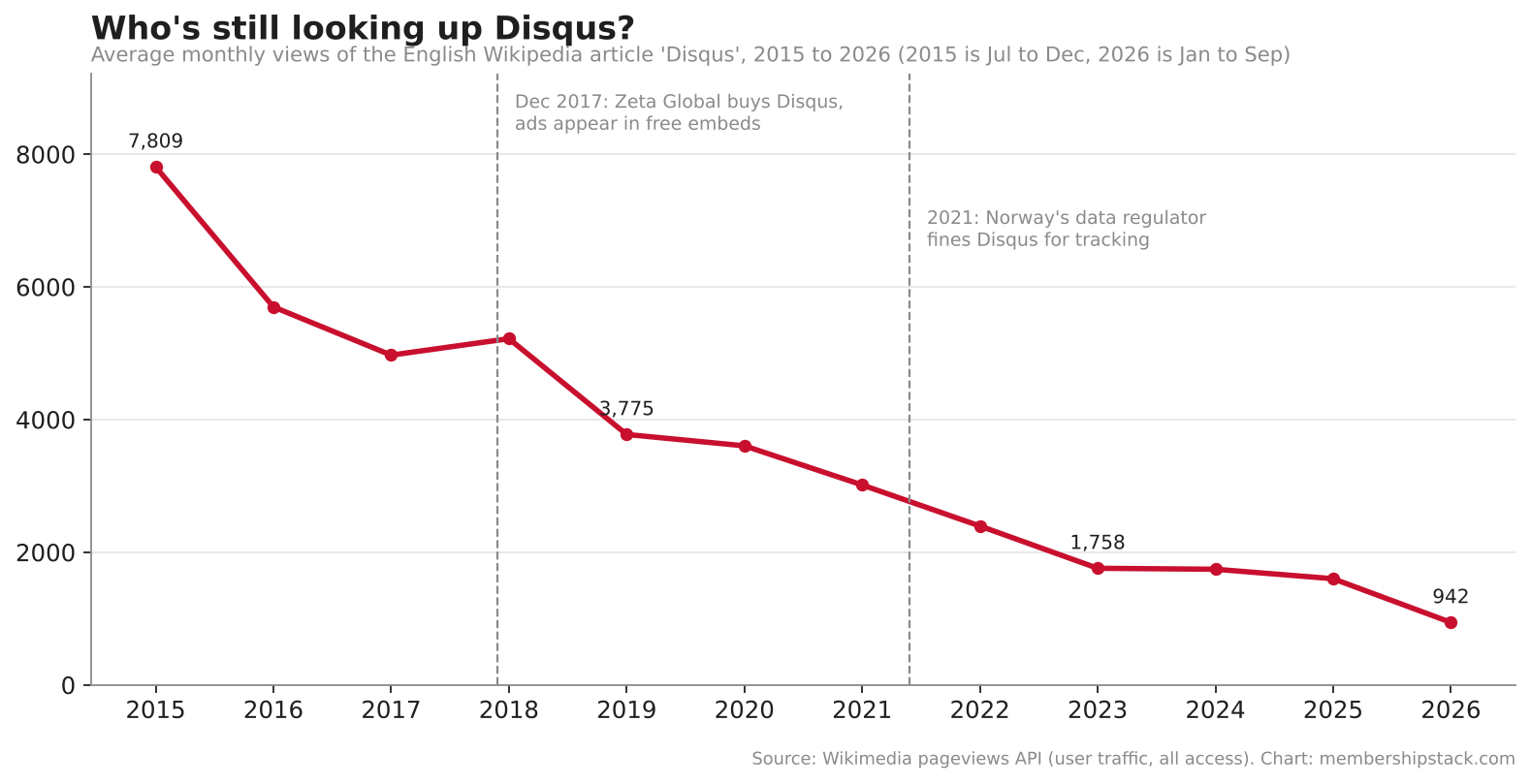
The first is a proxy for interest. Nobody publishes Disqus's traffic, and the SEO tools I pay for wouldn't give me historical numbers at my plan level, so I went to the most boring reliable dataset I could think of: how many people look up the Wikipedia article for "Disqus" each month. It's a crude signal. It also happens to be one that nobody can game, and it goes back to 2015.
| Year | Avg monthly views |
|---|---|
| 2015 (Jul to Dec) | 7,809 |
| 2016 | 5,698 |
| 2017 | 4,971 |
| 2018 | 5,219 |
| 2019 | 3,775 |
| 2020 | 3,604 |
| 2021 | 3,014 |
| 2022 | 2,395 |
| 2023 | 1,758 |
| 2024 | 1,743 |
| 2025 | 1,600 |
| 2026 (Jan to Sep) | 942 |
Source: Wikimedia pageviews API, user traffic, all access.
An 88% decline in eleven years, with no recovery at any point. Not a dip. A slide.
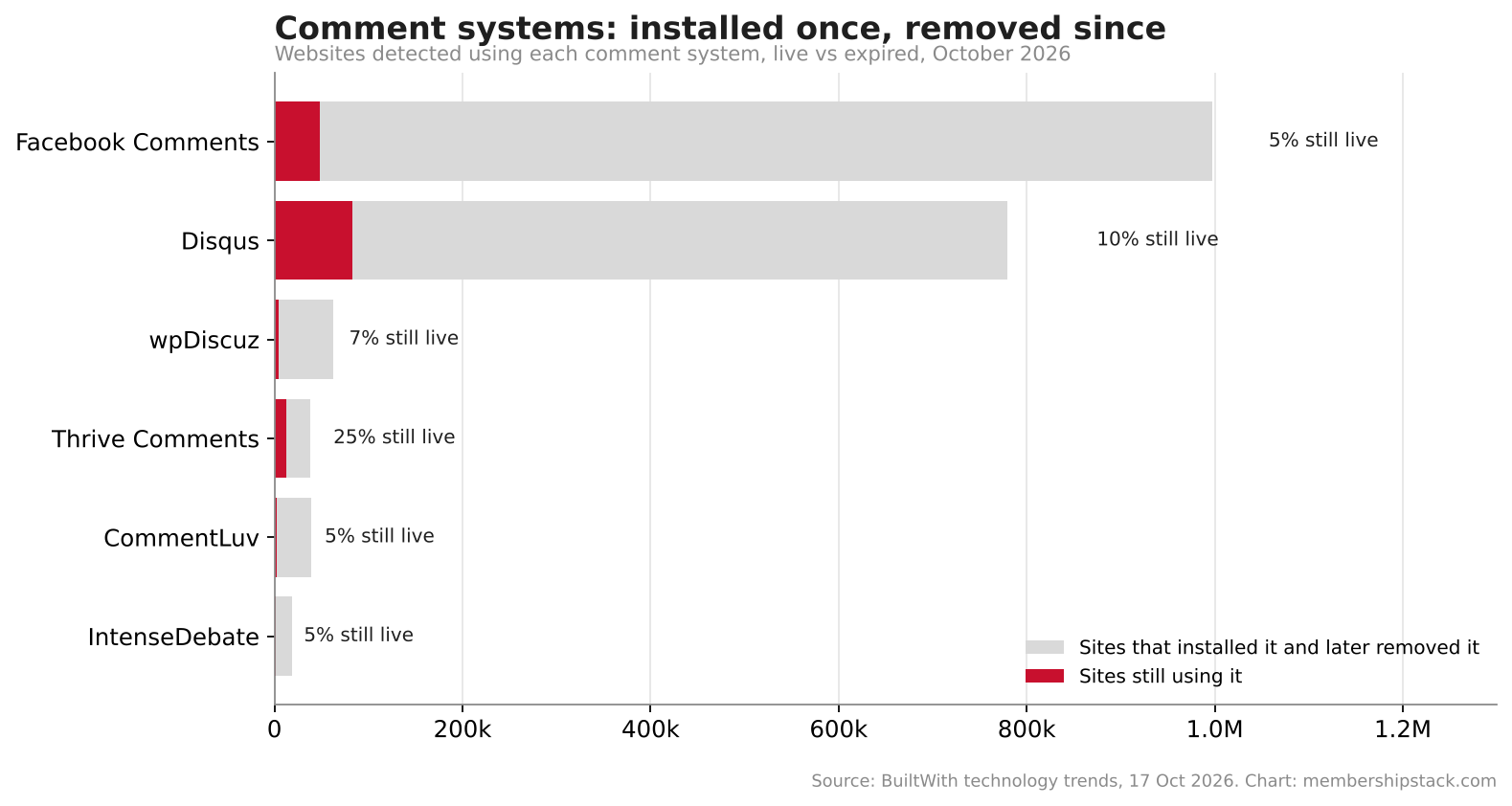
The second thing I checked is harder evidence. BuiltWith crawls the web and records which technologies a site uses, and crucially it keeps a record of sites that used something and then removed it. So you can see not just who's running a comment system today, but how many ran one and ripped it out.
| System | Still using it | Used it, then removed it | Still live |
|---|---|---|---|
| Facebook Comments | 48,085 | 997,259 | 5% |
| Disqus | 83,321 | 779,134 | 10% |
| wpDiscuz | 4,431 | 62,888 | 7% |
| Thrive Comments | 12,656 | 38,029 | 25% |
| CommentLuv | 2,144 | 39,335 | 5% |
| IntenseDebate | 960 | 18,333 | 5% |
Source: BuiltWith technology trends, 17 October 2026.
Read that top line again. Roughly a million sites installed Facebook's comment box. Forty-eight thousand still have it. Ninety-five out of every hundred sites that tried it took it out.
Disqus is the "healthy" one in this table, and nine out of ten of its installs are gone. Of the top 10,000 sites on the web, 66 run Disqus. Of the top 1,000, it's 16.
That's the body. Now the suspects.
Suspect 1: Disqus, which killed itself
Disqus started in 2007, two guys out of Y Combinator, Daniel Ha and Jason Yan, with a simple pitch: comments are hard, let us host them. One account, every site. You'd leave a comment on a gadget blog and your identity followed you to a politics blog. It was free, it was everywhere, and for a few years it was the obvious choice.
Here's the thing about "free and everywhere." It has to get paid for eventually, and the way it got paid for is the first fingerprint.
Around 2017 the deal changed. Sites running Disqus started seeing ads inside the comment widget. Not their ads. Disqus's ads. If you wanted them gone, you paid a monthly fee. For a hobby blogger who'd installed Disqus because it was free, this felt like a landlord showing up to charge rent on a room you'd built yourself. The ads were ugly. They were the chumbox kind, "one weird trick" and "you won't believe what she looks like now." They loaded in the one spot on the page where you'd asked your readers to trust you with their words.
Then in December 2017 Disqus was acquired by Zeta Global. Zeta is not a comments company. Zeta is a marketing-data company. The reported price was around $90 million, which for a product on that many sites is not a lot, and tells you something about where the business already was.
And this is where the comment box stopped being a comment box.
When a data company buys a widget that sits on hundreds of thousands of sites and sees every visitor, you don't need a detective to work out what the widget is for now. The comments were the cover. The visitor data was the product.
Which brings us to the second suspect, because the data business is exactly what the regulators came for.
Suspect 2: The privacy liability (and yes, the cookie banners)
The question I started with was whether the privacy problem with embedded comments is part of the same story as the EU cookie banners that get shoved in everyone's face and that nobody reads. Short answer: yes, it's the same story, and the comment box is one of the clearest examples of how that story played out.
Let me lay it out in order, because the order matters.
2009 to 2011: the cookie law. The EU amended its ePrivacy Directive to say that storing or reading anything on a visitor's device (a cookie, basically) requires their consent, unless it's strictly necessary to deliver what they asked for. Member states wrote it into law around 2011. This is the origin of the cookie banner. The early ones were a polite grey bar that said "we use cookies" and went away when you scrolled. Nobody read them because there was nothing to decide.
2018: GDPR. The General Data Protection Regulation made the consequences real. Fines of up to 4% of global turnover. A definition of "personal data" wide enough to cover an IP address and a device fingerprint. And a principle that hadn't really been enforced before: if you collect someone's data, you have to be able to say what for, and they have to have agreed.
2019: two court rulings that put the knife in.
The first is called Fashion ID. A German retailer had Facebook's Like button on its site. The button loaded Facebook code, which sent visitor data to Facebook whether or not anyone clicked. The Court of Justice of the EU ruled in July 2019 that the website owner was a joint controller of that data, alongside Facebook. In plain terms: if you embed someone else's widget and it phones home, you're on the hook for what it does.
A Like button and a Facebook Comments box are the same mechanism. So is a Disqus embed. Every one of them loads a third-party script that sees every visitor, logged in or not, commenting or not.
The second ruling is Planet49, October 2019. A pre-ticked box doesn't count as consent. Consent has to be an active choice. That's why the polite grey bar turned into the thing we have now, the wall of toggles with "Reject all" hidden behind "Manage preferences." The banner nobody reads got worse because the law got stricter, which is a bleak joke the regulators have never found funny.
2021: Norway fines Disqus. The Norwegian data authority announced its intention to fine Disqus about 25 million kroner (roughly US$3 million at the time) for tracking visitors on Norwegian news sites and sharing the data with advertisers, without consent. The part of this story I love, and I'm going by the regulator's own account here, is Disqus's reported explanation: they didn't think GDPR applied in Norway. Norway isn't in the EU. It is in the European Economic Area, which adopted GDPR. A company whose business was now visitor data hadn't checked which countries the data law covered.
So put yourself in the shoes of a publisher in 2019 or 2020. You've got a free comment widget that:
- loads a third-party script on every page,
- that script tracks every visitor and feeds a marketing-data company,
- a court has just said you're jointly responsible for whatever it does,
- and the only way to stay clean is to block the widget until the visitor clicks "Accept" on a banner, which means the comments don't load for anyone who clicks "Reject," which is a lot of people.
You'd rip it out. A million sites did.
Is the cookie banner the murderer? No. But it's the reason the murder got reported. Before GDPR, the tracking was happening and nobody had to disclose it. After GDPR, every embedded comment box came with a legal exposure, a slower page, and a consent gate in front of the one feature you wanted people to use. The banners nobody reads are the visible scar of a law that made third-party embeds a liability. Comments were collateral.
Suspect 3: Google, which made slow a crime
While the lawyers were circling, Google was doing something quieter.
In 2010 Google announced that page speed was a ranking factor on desktop. In 2018 it extended that to mobile (the "Speed Update"). In 2021 it rolled out Core Web Vitals, which turned "speed" into three specific measurements that every SEO on earth started obsessing over, including one called Cumulative Layout Shift, which penalizes pages where things jump around while loading.
Now think about what a comment embed does.
It's a third-party script. It loads after your content. It injects an iframe of unknown height into the bottom of your page, which shifts everything below it. It makes a dozen requests to someone else's servers. On a slow connection it's the last thing to appear and the first thing to fail.
I remember the Facebook Comments plugin on blogs very clearly, because I used to watch it load. The post would be there. The sidebar would be there. And then, a beat later, sometimes two or three, the comment box would stutter into existence, pushing the footer down, and then populate itself one comment at a time like a slot machine. On mobile it was worse. Sometimes it just never came.
In 2011 that was a tolerable price for a feature everyone wanted. By 2021, with Google telling you that exact behaviour would cost you rankings, it was a cost with no offsetting benefit. The comment box had become dead weight you were paying for in traffic.
There's a well-known data point here from WPBeginner, one of the biggest WordPress tutorial sites. They removed Disqus and went back to native WordPress comments, and reported a 304% increase in comments. The usual explanation is that Disqus's load time and login friction were suppressing participation. I believe it. But notice what the experiment didn't show: it didn't show that comments were worth having. It showed that if you want them, the embed is the wrong way to get them. Most sites took the first half of that lesson and skipped the second.
Suspect 4: Spam, and the plugins that invited it
This one goes back further than the others, and it's the suspect everyone forgets because it was already a crime scene by the time the rest showed up.
In 2005 Google, Yahoo and Microsoft jointly introduced rel="nofollow", specifically because blog comments had become a link-spam machine. If a link in a comment passed SEO value, every comment box on earth was a free billboard, and the spammers knew it before the bloggers did. Akismet, the spam filter that ships with WordPress, launched the same year and has since blocked a number of spam comments that's measured in the hundreds of billions.
Think about what that means. The comment section was under industrial attack from the moment it mattered. Every blogger who ever ran one remembers the morning they opened the moderation queue and found 400 messages about handbags.
And then the industry did something strange: it built plugins to re-enable the thing nofollow was designed to kill.
CommentLuv was the famous one. Install it and every commenter got a link to their latest blog post appended to their comment, and the link was dofollow. The pitch was community: reward people for commenting by sending traffic back to them. The result was predictable. Lists of "CommentLuv-enabled blogs" circulated in SEO forums. People hired commenters by the hundred. The blogs that installed it to build community found they'd built a spam farm with better manners. Look at the table above: 39,000 sites removed it; 2,000 kept it.
There was a whole genre of these. "Top Commentators" widgets that put your most prolific commenters in the sidebar (so people commented prolifically). KeywordLuv, which let you put your target keyword in your name field. Comment-for-comment groups. The whole apparatus taught a generation of bloggers that comments were a currency to be farmed rather than a conversation to be had, and when the currency devalued, they stopped showing up.
I think this suspect deserves more weight than it gets. The platforms and the regulators killed the tools. The spam economy had already killed the point.
Suspect 5: The publishers who pulled the plug first
The big sites didn't wait to be forced. They went first, and they wrote essays about it.
Popular Science shut off comments in 2013, with a post arguing that trolls were distorting how readers perceived the science. Copyblogger, which had spent a decade telling bloggers that comments were the heart of a blog, turned theirs off in 2014. Reuters did it the same year. The Verge paused comments in 2015 to "get a break" from the tone. NPR removed them in 2016. IMDb killed its message boards in 2017, boards that had been running for sixteen years.
The stated reasons were always some version of: the conversation has moved to social media, the comments we get are low quality, and moderating them costs more than they're worth.
All three were true. But here's what I think was actually going on, and this is a guess. For a big publisher, a comment section is a liability with no revenue line. Every nasty comment is a brand risk. Every moderator is a salary. And the engagement that used to justify it (people coming back to check replies) was now happening on Twitter, where it also generated referral traffic. The maths wasn't close.
What the big sites did gave everyone else permission. If NPR doesn't need comments, why does your gardening blog?
Suspect 6: The platforms that swallowed the conversation
This is the one I think did the most damage, and it's also the one that connects directly to what this directory is about.
Comments on a blog have a structural problem. When someone replies to you, how do you find out?
In 2009 the answer was an email notification from the blog, if the blogger had set it up, which they usually hadn't. So you left a comment, and you never came back, and the person who replied was talking to an empty chair. A comment section is a conversation with no way to tell anyone the conversation is happening.
Twitter solved that. Facebook solved it better. The notification loop, the little red number, the "someone replied to your comment," that's the entire engine. It's not that people stopped wanting to argue about blog posts. It's that arguing about them on Twitter came with a return trigger and arguing about them on the blog didn't.
So the conversation moved. First to Twitter, where you'd tweet the link and the comments happened in the replies. Then to Facebook Groups, where whole niches set up camp and the blog post became a thing you shared into the group for discussion. Then, as Facebook's algorithm got stranger and its groups got noisier, to Discord and Slack. And now to Skool, Circle and the rest of the platforms listed on this site.
Watch what happened to the Facebook Comments plugin specifically, because it's the clearest case of a platform eating a feature and then discarding the bones.
Facebook launched the plugin in 2011. The pitch was irresistible: real names, real faces, no spam (because you had to be logged into Facebook), and the comment got cross-posted to the commenter's Facebook feed, so every comment was free distribution. TechCrunch adopted it with great fanfare and dropped it about eight months later, because it turned out that real names didn't stop people being awful and the cross-posting didn't send much traffic back.
A million sites installed it anyway. And here's the part that matters: those comments never lived on your site. They lived on Facebook's servers, rendered into an iframe. Facebook has been winding down its social plugins, and the Comments plugin is on the list. When it goes, the comments go with it. A million sites' worth of reader conversation, gone, because it was never theirs.
I keep saying on this site that Facebook is shaky ground to build on. This is what I mean. It's not a prediction. It's a pattern with a body count.
Interlude: the webinar trick
I want to tell a smaller story here, because it's the one that made me realize what the Facebook Comments plugin had actually become by the end.
If you were in the internet-marketing world around 2013 to 2017, you'll remember this. Someone runs a webinar. Below the replay, or on the sales page, there's a Facebook Comments box. And it's full. Dozens of people with real names and real profile photos saying "this was incredible," "just signed up," "best training I've seen all year."
That box wasn't there for conversation. It was there as proof. Real proof, in the sense that these were real Facebook accounts and not testimonials typed by a copywriter. You could click a face and see a real person. That mattered, in an industry where every other claim was fake.
I'll also say the quiet part. It was gameable. You could seed it. You could ask your affiliates to drop a comment. You could, if you were that kind of operator, run the webinar through your own warm list first so the box was full before the cold traffic arrived. And none of the people reading it could tell the difference between a comment that arrived organically and one that was solicited.
Then it loaded slowly. Then it needed a cookie consent. Then Facebook changed the API. The "real proof" box went from a clever tactic to a broken widget in about four years, and it was replaced by the thing we have now: screenshots of comments, pasted in as images, which can't be clicked and can't be verified and are therefore worth nothing. We went from real proof to a picture of real proof.
That's the whole arc of blog commenting in miniature. A feature that worked because it was real, degraded by the people who used it until it was a prop, then killed by the infrastructure underneath it.
Suspect 7: The slow fade of the independent web
This one is less a suspect than an atmosphere.
The blogosphere, as a thing with its own name and its own etiquette, peaked around 2008 to 2012. Blogs linked to each other. Comment sections were where you found other blogs. You'd read a good comment, click the name, find a site, subscribe to its RSS feed. The network was horizontal. Then Google Reader shut down in 2013, Facebook's algorithm started deciding what you saw, and the horizontal web got folded into a handful of vertical feeds.
Google+ had a comments feature for Blogger. Google killed Google+ in 2019 and the comments went with it. Livefyre, which was Disqus's main competitor and had an actual real-time product that worked, was bought by Adobe in 2016, folded into Adobe's enterprise stack, and the standalone comment product disappeared. IntenseDebate, which Automattic had bought back in 2008, was shut down in 2023 with barely an announcement. Disqus is owned by a data company. Facebook's plugin is on death row.
Of the comment systems that mattered in 2012, the only one still standing in anything like its original form is the one built into WordPress, and it's the one everybody spent a decade replacing.
The tools didn't die in a wave. They died one at a time, over ten years, each one quietly enough that nobody wrote the obituary. That's how you get a graveyard without a funeral.
The verdict
So who did it?
I've gone back and forth on this, and I've landed where every good mystery lands: everybody did. It's the train in Murder on the Orient Express. Each suspect put the knife in once.
- Spam killed the point of comments before anything else arrived.
- Disqus's ads and data business made the most popular tool something you were embarrassed to have on your site.
- GDPR and the 2019 court rulings turned every embed into a legal exposure, and the consent banners that followed put a locked door in front of the comment box.
- Google's speed obsession turned the slow-loading widget into a ranking penalty.
- The big publishers removed theirs and gave everyone else permission.
- The platforms built the notification loop that blogs never had, and the conversation followed the loop.
- And the independent web thinned out around all of it, so there were fewer people to comment anyway.
If you want a single sentence: comments died because a conversation needs a reason to come back, and blogs never built one. Everything else is detail about how the tools that tried to fake that reason fell apart.
Where the lights are still on
Here's what I find interesting, and it's the reason this piece is on a directory of community platforms rather than a blog about blogging.
Commenting didn't die. It consolidated. Comments are enormous on YouTube, Instagram, TikTok, X, Reddit. They're the entire product on Skool and Discord and Circle. The comment section is bigger than it has ever been. It just only works in places with three things a blog can't offer: a huge logged-in audience, a notification loop, and an algorithm that rewards the commenter for commenting.
Look at the platforms listed on this site through that lens and they stop looking like "community software" and start looking like what they are. Skool is a comment section with a login, a daily digest email, and a leaderboard. Circle is a comment section with spaces. Discord is a comment section that never stops scrolling. Every one of them is the blog comment box with the three missing pieces bolted on, and people pay $99 a month for it, which tells you exactly how much the three pieces were worth.
And then there's YouTube, which I think is the most under-used comment section on the internet from a marketing standpoint.
Think about what a YouTube comment is. It's public. It's attached to a video with a known audience. It's shown to that audience in an order the algorithm decides, and the algorithm likes comments that get replies and likes. The creator sees it, and if it's good, the creator pins it or replies, and now you're in the conversation with the creator's whole audience watching. There is no other place on the web where a stranger can leave a thoughtful paragraph and have it put in front of ten thousand relevant people for free.
Marketers mostly ignore it. They'll spend money on ads and hours on LinkedIn posts, and never leave a useful comment on the channels where their customers already are. Which is why I built VidCommenter. It finds smaller channels in a niche, summarizes the videos, and suggests a comment worth leaving, one that adds something rather than "great video, check out my link." It's the 2011 commenting playbook, minus the spam, moved to the one place where the comment box is still alive and the people are still reading.
I'm obviously biased about that. But the underlying point stands without the tool: if you're still looking for the comment section, it isn't under your blog post anymore. It's under somebody else's video.
What this means if you're choosing a platform
Three things, and then I'll stop.
Don't build on an embed. Facebook Comments, Disqus, any widget that renders someone else's content into an iframe on your page. A million sites learned this. The comments were never yours, and when the widget dies they go with it. The same logic applies to Facebook Groups, which is why we're blunt about it on the listing.
Export matters more than features. The reason this directory has a field for what each platform lets you export is this exact history. Disqus had an export. Facebook Comments didn't. When you're picking between Skool and Circle and whatever launches next year, ask what you walk away with. Every listing here says.
The digest is the product. When you see that nearly every platform on this site sends a daily or weekly email summarizing what happened, and that the ones who don't tend to struggle, now you know why. The notification loop is the thing blogs never had. It's the thing that keeps the conversation alive. A community platform without a return trigger is just a blog with comments, and we know how that ends.
Data in this piece: Wikipedia pageviews from the Wikimedia API; technology install counts from BuiltWith trends pages, pulled 17 October 2026. Historical events are from the companies' own announcements and the court rulings cited, except where I've marked something as a guess. Corrections welcome.